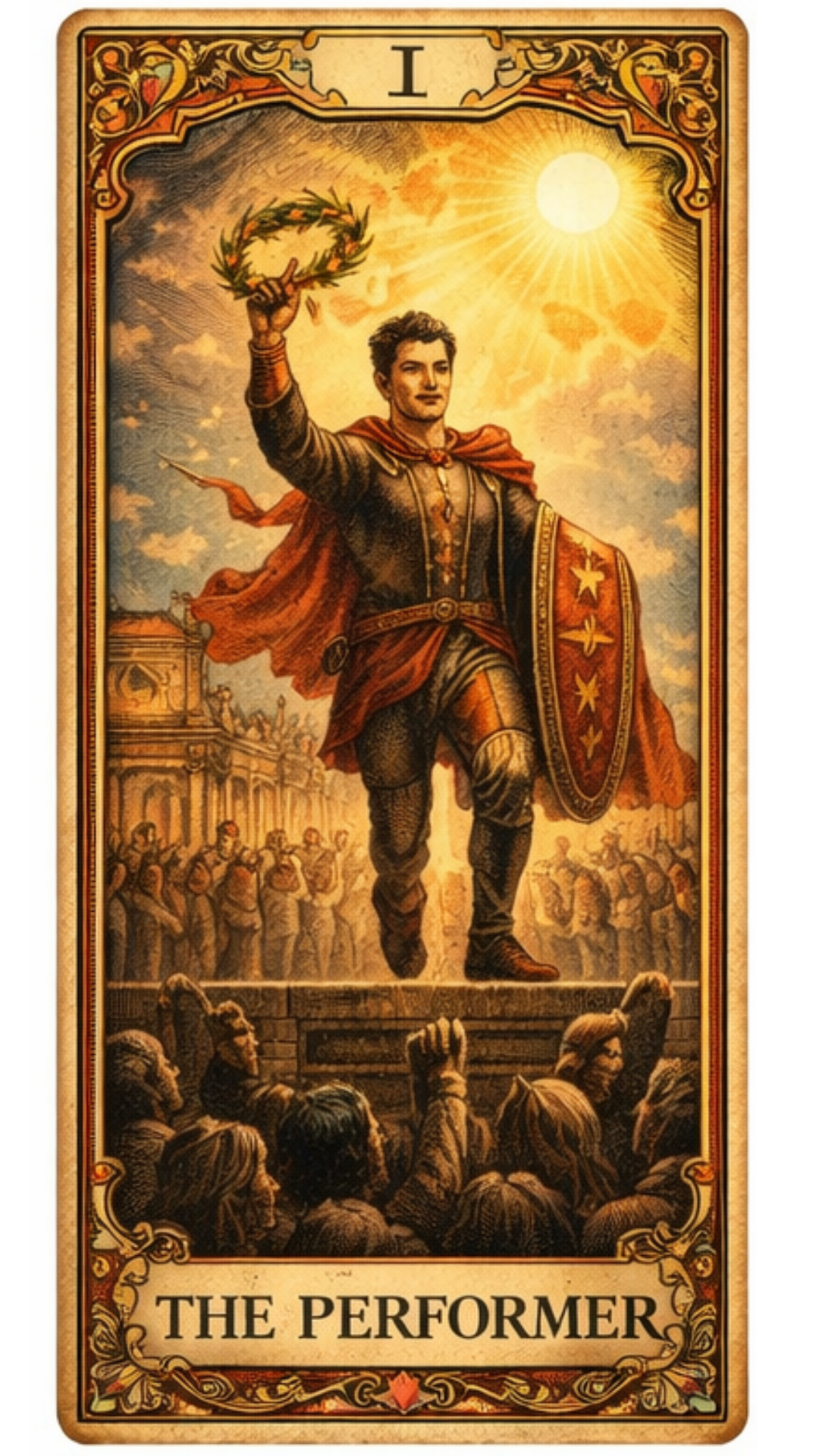
Shadow CEO Archetype Series — Part One
I passed a state healthcare certification exam with a 98.
I didn’t know that yet when I signed off with the proctor. What I knew in that moment was simpler: I had passed. And after weeks of quietly holding my breath, that was enough to finally let it go.
I mean that literally. The moment the screen went dark, I exhaled — one of those full-body releases that tells you, only on the way out, exactly how much weight you’d been carrying.
Here’s what I’d been carrying: I had backed this exam up to the absolute last possible day. Not strategically. Not confidently. I’d just kept moving other things to the front of the line until there was no line left. If I hadn’t passed, I couldn’t go to work on Friday. No cushion. No backup plan. Just a quiet, low-grade pressure that had been humming underneath everything for weeks — so normalized I’d stopped registering it as fear.
That’s the Performer’s signature move. She doesn’t panic. She just holds her breath and keeps executing.
So I exhaled. Felt the weight lift. Looked around at the ordinary afternoon that had just stopped being a threat.
And then, before the relief had even finished landing, I felt the pull.
Okay. What’s next?
Not panic. Not urgency, exactly. Just that familiar forward lean. The internal scan for the next thing to prove, the next thing to earn, the next place to put my energy so it looked like progress. Something in me was already reaching before I’d fully arrived in the moment I’d just worked so hard to get to.
This time, I caught it.
I didn’t reach. I stayed — with the exhale, with the passing grade I wouldn’t see for hours, with the quiet of a Wednesday afternoon that asked nothing of me. I let it be enough, even though every trained instinct said it wasn’t time to stop yet.
It was one of the hardest things I’d done all week. Harder than the exam.
That moment — the noticing, the pause, the choosing differently — is what this entire body of work is built around.
Because I’ve been doing the other thing my whole life. On construction sites at twenty-two, directing a hundred men with a competence I performed so consistently that no one would think to question whether I belonged there. In my marketing agency for fourteen plus years, producing results I’d immediately discount the moment a client praised them. In the healing work I do now in addition to my marketing agency, where I sometimes catch myself preparing for a workshop with the same tight chest and shallow breath I used to bring to a job site walkthrough.
The setting changes. The archetype doesn’t.
If you’re reading this and something in your chest already recognizes what I’m describing — that particular exhaustion of being very good at things and still not feeling like enough — then you’ve already met her.
Her name is The Performer.
Who She Is
The Performer isn’t the villain of this story. She never was.
She’s the part of you that learned, somewhere early, that excellence was currency. That if you were exceptional enough — skilled enough, productive enough, visible enough in the right way — you would be safe. Loved. Unchosen by the kind of loss that comes when you’re ordinary.
She is probably the reason you’ve built what you’ve built. She knows how to execute. She shows up. She delivers. She rarely lets people down.
But she also can’t stop. Can’t fully exhale. Can’t let a launch be good enough without making it exceptional. Can’t publish a post without editing it one more time. Can’t receive a compliment without immediately deflecting to what still needs work.
She is brilliant. And she is exhausted. And somewhere underneath all that output, she is terrified.
What She’s Protecting
Here’s what the Performer never says out loud:
If I stop producing, I lose my value. And if I lose my value, I lose everything.
This isn’t a belief you chose. It’s one that was written into your nervous system long before you had words for it.
Maybe you were the kid who got praised for achievement and ignored during ordinary moments. Maybe you had a parent whose love felt conditional — present when you performed well, distant when you didn’t. Maybe you grew up in an environment where being exceptional was the only way to stay safe, stay seen, stay chosen.
The Performer doesn’t develop in people who were unconditionally loved. She develops in people who learned that love had to be earned. And once that equation is written in the body, it runs in the background of everything — every launch, every offer, every piece of content you create.
She’s not a flaw. She’s a protection. She just became your default operating system without your permission.
How She Shows Up in Your Personal Life
The Performer in your personal life looks like:
Rest that feels stolen rather than deserved. You lie down and your mind starts cataloguing what still needs doing, what you should be building, what you’re falling behind on. Rest only feels okay when it’s earned and it’s never quite earned enough.
Relationships that get the leftover version of you. By the time you’ve performed all day — in your business, your content, your public-facing identity — there’s not much left. The people closest to you get the exhausted, deflated version. The one who’s too tired to perform but doesn’t know how to just be.
A deep discomfort with being witnessed in ordinary moments. You can be seen as excellent. You can be seen as a leader, a teacher, a creator, a mother. But just seen — quiet, unproductive, average on a Tuesday afternoon — that feels uncomfortably close to invisible.
Somatically, this lives in your chest. Tight. Shallow. A subtle but constant forward-leaning urgency, like your body is always just slightly ahead of the present moment, reaching for the next thing to prove.
How She Runs Your Business
In your business, the Performer is everywhere.
She is the reason you over-deliver on every client engagement — adding value no one asked for because somewhere inside, the value justifies your place at the table.
She’s the reason your pricing doesn’t match your expertise. Not because you don’t know your worth intellectually. But because charging what you’re actually worth means people might say no. And a no doesn’t feel like market feedback — it feels like rejection. Like evidence that when you’re not exceptional, you’re not enough.
She’s why launches feel like performances rather than invitations. Every post a production. Every email a chance to prove you belong in people’s inboxes. Every workshop an opportunity to be exceptional enough that no one regrets showing up.
She’s why you’re exhausted in cycles you can’t quite explain. You push until you can’t. You disappear. You come back and push again. The business mirrors the nervous system: on, off, on, off, never quite settling into sustainable rhythm.
She’s also why you’re inconsistent in ways that confuse you. Because performing at high levels requires a specific kind of fuel — urgency, adrenaline, the feeling of something to prove. When that fuel isn’t there, neither is the output. And then the shame of the inconsistency becomes its own performance to recover from.
Where She Came From
I spent fifteen years in construction. I was young and female in environments where both of those things were liabilities. So I learned to out-execute everyone in the room. I didn’t ask to be liked. I asked to be undeniable.
That was survival. And it worked.
What I didn’t know then was that the strategy that kept me safe on a job site would follow me into every room I ever entered after that. Into my agency. Into my relationships. Into my healing work. Into the moment I passed a certification exam with a 98 and felt nothing.
The Performer was built in your specific context. Maybe it was a father whose approval felt just slightly out of reach. Maybe it was a school system that rewarded achievement and ignored everything else. Maybe it was an industry that only made space for you when you were exceptional.
The wound underneath the Performer is usually some version of this: I was not enough just as I was. So I became someone who could not be questioned.
That was smart. That was adaptive. And now it’s running your company without your consent.
The Turning Point
There was a moment, the night before a workshop I was leading, when I sat at my desk surrounded by a script I’d written, somewhat memorized, and was still not satisfied with.
I’d been revising for hours. Not because it wasn’t good. It was good. But because “good” wasn’t safe. “Good” could be questioned. Exceptional couldn’t be.
And somewhere in the middle of rewriting a paragraph that was already true, my body just… stopped.
Not dramatically. Not in a breakdown. Just a quiet, cellular kind of exhaustion. The kind that arrives when you’ve been performing for so long that even the part of you that knows how to perform is tired.
I put down the script. I went to the workshop. I spoke from what was actually true in that moment — which was that I was nervous, stretched across multiple timelines of my life, and standing in front of these women with all of my shadow archetypes present and accounted for.
It was the most honest I’d ever been in front of an audience.
And it was better than anything I’d rehearsed.
That’s what the Performer doesn’t know yet: the thing people actually want from you isn’t your most polished version. It’s your most true one.
The Integration: From Performer to Conscious Creator
Integrating the Performer doesn’t mean dismantling your excellence. It means unhooking it from your worth.
You are allowed to be skilled. You are allowed to create beautiful, high-quality work. You are allowed to deliver at a high level because it feels aligned — not because you’re terrified of what happens if you don’t.
Here’s what that shift actually looks like, in the body and in the business:
In your nervous system: You start noticing the difference between urgency and aliveness. Urgency feels like forward-lean, shallow breath, a tightness that says move move move. Aliveness feels like expansion, depth, a groundedness that says this is real. One is the Performer running. The other is you choosing.
In your content and visibility: You experiment with sharing from what’s true instead of what’s impressive. One honest post that lands in someone’s body is worth more than ten polished posts that perform well and touch no one.
In your pricing and offers: You practice holding your number. Not explaining it. Not over-justifying it. Not discounting it the moment someone hesitates. You let the price be the price, and you trust that the people meant for your work will find their way to it.
In your rest: You start giving yourself permission to stop before you’ve earned it. This is the hardest one. The Performer believes rest is a reward. Integration knows rest is a requirement — not for productivity, but for being a full human being.
A journaling practice to begin: Sit with your hands on your chest. Feel your breath before you try to change it. Then ask yourself: Where in my business am I still trying to earn what I already am? Write from that place for ten minutes. Don’t edit. Don’t perform the answer. Just let it come.
The Gift Inside This Archetype
When the Performer integrates — when excellence stops being a hiding place and starts being an expression — something remarkable becomes available.
You stop creating to prove and start creating to say something. The work gets quieter and more powerful at the same time. You make decisions faster because you’re no longer running everything through the filter of will this be impressive enough?
You start to notice what you actually want to build, not just what you’re capable of building. And those are often very different things.
Your clients feel the difference. There’s a quality of presence that only becomes available when you stop performing for them and start being with them. That’s when the work goes from good to genuinely transformational.
You become the kind of leader people trust not because of your credentials but because of your honesty. Because they can feel that you’re not managing an impression. You’re actually there.
That is the Performer’s gift, fully integrated: not less excellence, but excellence that comes from the inside out.
This Is Your Invitation
If you recognized yourself in these pages — in the tight chest, the rest that feels undeserved, the launch that has to be exceptional or it doesn’t feel safe — I want you to know something.
You are not too much. You are not broken. You are not doing the work wrong.
You are carrying a strategy that once made perfect sense. And you are ready, at some level, to put some of the weight down.
The Embodied Shadow CEO Experience is the container I’ve built for exactly this work. It’s where we take the pattern out of the background and into the light — in your body, your business, your relationships, and your leadership.
We don’t fix the Performer. We meet her. We understand what she’s been protecting. And we give her something she’s never had before: permission to rest, because the CEO running the show now doesn’t need to prove anything to anyone.
Frequently Asked Questions
What is the Performer archetype and how do I know if it applies to me?
The Performer is one of the Shadow CEO archetypes — an internalized pattern of behavior that develops when you learn early in life that your value is tied to your output. If you’ve ever finished something significant and felt nothing but the pull toward what’s next, undercharged for your work despite knowing your worth, or found rest genuinely uncomfortable unless you’ve “earned” it, the Performer is likely running in the background of your business and your life.
Is the Performer archetype a flaw or something to fix?
Neither. The Performer developed as a protection — a smart, adaptive response to an environment where love, safety, or belonging felt conditional on achievement. The goal of this work isn’t to dismantle your drive or your excellence. It’s to unhook those qualities from fear, so they can become expressions of who you are rather than strategies for staying safe.
How is this different from simply being ambitious or having high standards?
Ambition and high standards feel expansive — they pull you toward something you genuinely want. The Performer feels more like pressure from behind. The distinction lives in the body: ambition has a groundedness to it, while the Performer tends to show up as a tight chest, shallow breath, and a forward lean that never quite lets you land in what you’ve already built. One is a choice. The other is a pattern running without your consent.
Can the Performer archetype affect my personal relationships, not just my business?
Absolutely — and often more quietly. By the time you’ve performed all day in your business and your public-facing identity, the people closest to you tend to get what’s left. The Performer also struggles with being witnessed in ordinary moments, without a role to play or a result to produce. Intimacy requires presence without performance, which is exactly where this pattern creates the most invisible damage.
I recognize myself in this article. Where do I start?
Start where you are right now. The journaling practice at the end of the article — hands on your chest, breath before thought, and the question “where in my business am I still trying to earn what I already am?” — is a genuine entry point, not a placeholder. The integration doesn’t begin when you sign up for a program. It begins the moment you stop and actually look at the pattern.
What does “integrating” the Performer actually mean in practice?
Integration means the Performer stops running the show unconsciously and starts working with you consciously. Practically, that looks like noticing the difference between urgency and genuine aliveness, holding your pricing without over-explaining it, sharing content that’s true rather than impressive, and giving yourself permission to rest before you’ve earned it. It’s less about doing less and more about doing things from a different place inside yourself.
What is the Shadow CEO Integration Experience?
It’s the container built specifically for this work — where the patterns described in this article move from background noise into conscious leadership. It addresses the Performer and the other Shadow CEO archetypes across four areas: your nervous system, your business, your relationships, and your identity as a leader. It’s designed for people who have already built something real and are ready to stop letting their shadows run it.
Is this therapeutic work or business coaching?
It sits deliberately at the intersection of both. The Shadow CEO archetypes live in the body and the business simultaneously — you can’t fully address one without the other. This work draws on somatic awareness, nervous system understanding, and practical business strategy to create change that holds, rather than insight that fades.
How long does it take to integrate the Performer archetype?
There’s no clean timeline, and anyone who gives you one isn’t being straight with you. What most people experience is a fairly quick shift in awareness — you start catching the pattern in real time, the way the article describes catching the pull toward “what’s next.” The deeper integration, where the pattern genuinely loosens its grip on your decisions and your body, unfolds over months of consistent practice and support. The goal isn’t perfection. It’s the pause. And the pause becomes available faster than most people expect.





0 Comments