
Published: December 4, 2025, 11:00 AM EST
Business Marketing: Comprehensive Strategies and Effective Practices for 2026
Welcome, fellow changemakers! In a world buzzing with noise, business marketing in 2026 isn't just about transactions; it's about creating genuine connections, fostering trust, and making a meaningful impact. This isn't just strategy; it's an art of conscious communication and intuitive understanding. This guide dives deep into core concepts, modern digital pathways, B2B partnerships, and the heart of content and email. We'll explore emerging 2026 trends like ethical AI and first-party data, alongside practical, soulful measurement for businesses of all sizes. If you've ever felt a disconnect between your marketing efforts and truly resonant customer relationships, this article offers actionable frameworks and heartfelt examples to bridge that gap. You'll discover how to intuitively prioritize channels, build a content marketing funnel that truly serves, implement B2B and account-based approaches with integrity, embrace email automation that feels personal, and track the KPIs that reflect true impact. Together, we'll explore what business marketing truly means, compare top digital channels for authentic reach, outline B2B strategies that build lasting relationships, detail content and email funnels that nurture with care, explore the exciting 2026 trends, and offer budget-conscious guidance to elevate your ROI with purpose.
What is Business Marketing and Why is it Essential?
Business marketing is the coordinated set of practices that authentically positions your offerings, communicates genuine value to your ideal audience, and lovingly guides demand into revenue through channels that resonate with integrity. At its core, marketing is a beautiful dance between deep market insight, intuitive understanding of human needs, and tactical execution, all designed to help businesses acquire customers with heart, grow their impact, and sustain margins with purpose. Effective marketing, when done consciously, reduces acquisition cost, increases lifetime value, and builds brand differentiation rooted in trust over time. Clear positioning, consistent, heartfelt messaging, and a data-driven funnel help companies prioritize spend and optimize outcomes across channels with intention.
Business marketing serves three primary objectives that drive business performance with a conscious heart:
- Customer acquisition: Thoughtful outreach and conversion tactics that attract aligned customers and build a predictable, purposeful pipeline.
- Brand building: Strategic messaging and experience design that cultivate authentic preference and create a defensible, values-driven presence in the market.
- Revenue growth: Mindful pricing, promotion, and lifecycle marketing that transform demand into measurable sales and repeat business built on trust.
These objectives work together to gently guide prospects through awareness to purchase, and then into retention programs that reduce churn and increase customer lifetime value, all while honoring their journey. Understanding how acquisition, brand, and revenue interplay leads directly into the mechanisms marketers use to capture and scale growth across channels with integrity.
Defining Business Marketing and Its Core Objectives
Business marketing can be defined as the discipline that creates demand and sustains business growth by connecting product-market fit with measurable promotional tactics, all while staying true to your purpose. It does this by combining insightful research (market and competitor), heartfelt strategy (positioning and segmentation), and conscious execution (campaigns across digital and offline channels). Core objectives commonly include acquiring qualified customers with integrity, improving retention through lifecycle marketing that truly cares, strengthening brand equity built on authenticity, and driving profitable revenue with a clear conscience. For example, a product-led startup might focus first on acquisition channels like SEO and referral programs while concurrently building an onboarding flow that increases early retention and lifetime value through genuine connection.
Each objective requires different metrics and cadence: acquisition relies on conversion rates and cost-per-lead, retention emphasizes engagement and churn, brand tracking uses awareness and sentiment measures, and revenue uses revenue-per-customer and margin. Clarity on these objectives informs channel prioritization and resource allocation, which is the next practical step for marketers aiming to scale with purpose.
How Business Marketing Drives Customer Acquisition and Growth
Marketing drives acquisition and growth through a layered funnel that connects awareness, consideration, conversion, and retention with specific channel tactics and optimization levers, all guided by an intuitive understanding of your audience. Awareness leverages organic search, paid media, and social content to expand reach with integrity, while consideration focuses on valuable content marketing, empathetic email nurture, and authentic demos to qualify interest. Conversion depends on a seamless landing page experience, pricing clarity, and friction reduction, and retention uses thoughtful onboarding, proactive customer success, and respectful remarketing to increase lifetime value. A practical growth mechanism combines organic discovery (SEO), paid amplification (PPC), and referral or partner channels to create predictable acquisition flows that scale with purpose.
Tactics vary by stage: referral programs amplify satisfied customers, paid search accelerates market entry with intention, and content builds authority that lovingly reduces paid dependency over time. Measuring funnel conversion rates and cohort behavior identifies the highest-leverage improvements, which means marketers should optimize both channel mix and lifecycle touchpoints to convert initial interest into repeatable revenue streams built on trust.
Which Digital Marketing Strategies Are Most Effective for Businesses?
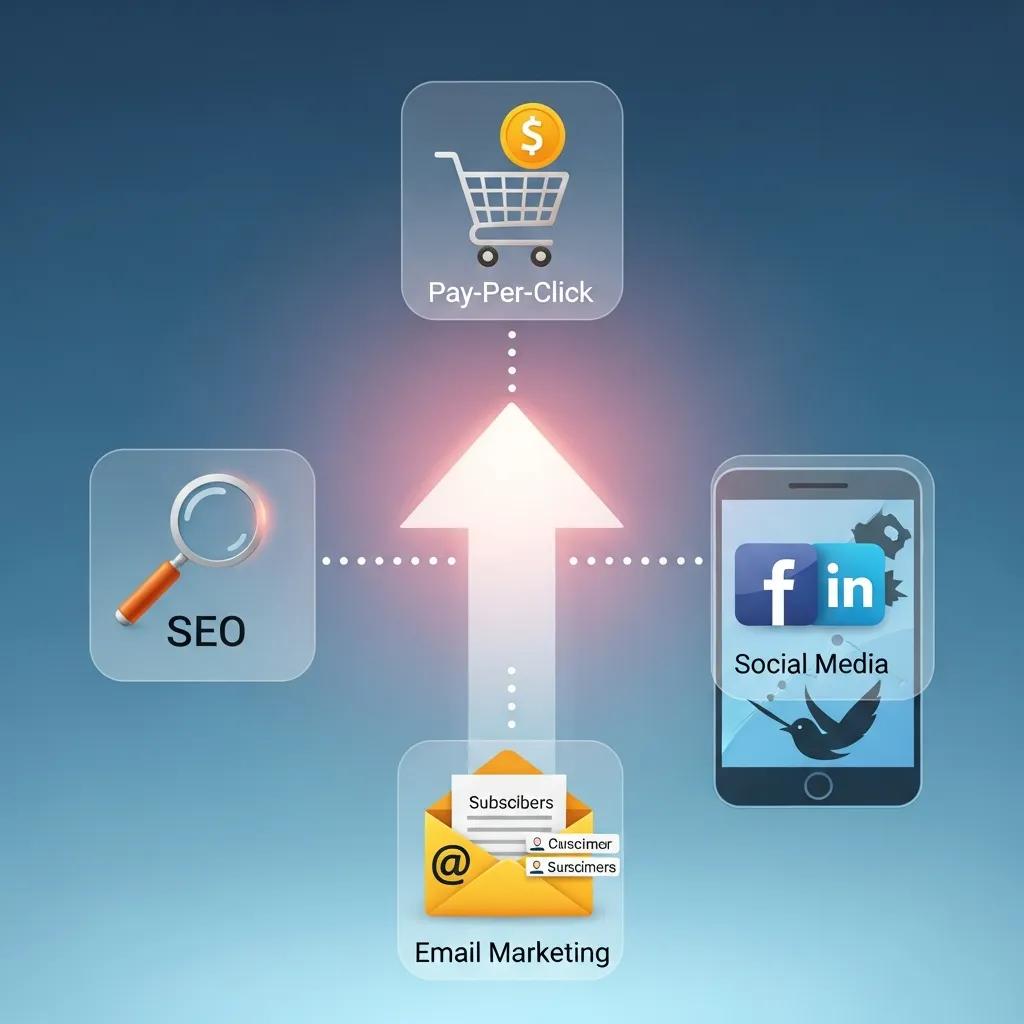
The magic of digital marketing truly unfolds when we align our strategies with our business's unique stage, our audience's deepest needs, and our heartfelt objectives. Consistently, channels like SEO offer sustainable, organic discoverability; social media fosters genuine engagement and community; email nurtures our owned audience with care; and PPC thoughtfully captures immediate demand. Prioritization isn't just about scale or efficiency; it's about building a brand with integrity and purpose. Startups might lean into paid and referral to spark early, conscious growth, while established brands invest in SEO and content to lovingly reduce acquisition costs over time. Understanding each channel's unique strengths and natural timelines helps us allocate our energy and measure our impact with intention.
Below is a comparison of major digital channels to guide strategic choices and tactical execution with a conscious approach.
This table compares digital channels, their core tactics, and when to prioritize them for conscious growth.
| Channel | Core Tactics | When to Use / Benefit |
|---|---|---|
| SEO | Keyword research, on-page optimization, technical fixes, content mapping | Use for sustainable, authentic organic traffic and to build long-term trust, reducing acquisition costs with integrity. |
| Social Media | Short-form video, community posts, paid social ads, influencer partnerships | Use for heartfelt brand awareness, genuine engagement, and to intuitively connect with your community. |
| Email Marketing | Segmentation, automated journeys, lifecycle campaigns | Use to nurture and retain your cherished audience, building deep relationships with high, purposeful ROI. |
| PPC Advertising | Search ads, display retargeting, performance bidding | Use for thoughtful demand capture, immediate, targeted reach, and to test messages with conscious intent. |
This comparison makes it clear that combining SEO and content investments with targeted paid campaigns and owned-email nurture creates resilient acquisition stacks that balance short-term results and long-term efficiency, all while building genuine connection. The following subsections break down SEO and social strategies and how to measure them with a conscious lens.
How Does SEO Improve Business Visibility and Reach?
SEO improves visibility by aligning content, site architecture, and technical signals with search intent so that relevant pages rank higher for target queries, connecting you with those who truly seek your offerings. The mechanism works through relevance (content authentically addressing user intent), authority (backlinks and trust signals built with integrity), and crawlability (technical health and structured data). Core tactics include prioritized keyword research, publishing topic-cluster content that truly serves, fixing technical issues like site speed and mobile usability, and earning backlinks through valuable, shareable resources. Quick wins come from optimizing high-intent pages and fixing technical errors; long-term growth requires consistent, valuable content and internal linking strategies that build a strong foundation.
Measuring SEO impact focuses on organic traffic, keyword ranking progress, and conversion metrics from organic channels. Regular audits and a content calendar tied to business objectives help sustain momentum and translate visibility improvements into pipeline growth, which leads naturally to integrating social strategies for amplification with a human touch.
What Role Does Social Media Marketing Play in Customer Engagement?
Social media marketing lovingly connects brands to audiences through content that encourages authentic interaction, community building, and short-form storytelling that drives awareness and consideration with heart. Platforms serve different roles: visual and video-first channels emphasize creative, heartfelt storytelling and short-form video, while professional networks support thought leadership and B2B outreach built on genuine expertise. Key content types include educational short videos, behind-the-scenes posts that show your human side, user-generated content that celebrates your community, and timely topical commentary that reflects your values. Engagement metrics like comments, shares, and watch time indicate resonance, while conversion-focused metrics include click-through rate and leads generated from social campaigns, always viewed through the lens of genuine connection.
A platform selection framework—matching audience demographics, content format, and business goals—helps focus effort where engagement yields measurable outcomes and builds true community. Consistent testing of creative and cadence, combined with repurposing high-performing content across channels, amplifies reach and feeds into owned channels like email for deeper, more personal nurture.
How Can B2B Marketing Strategies Enhance Business Relationships?
B2B marketing, at its heart, is about cultivating deep, meaningful relationships. It's a conscious dance that aligns marketing and sales through account-focused tactics, pipeline-centric content, and measurable enablement, all built on trust and mutual respect. Unlike B2C, the B2B journey often involves multiple stakeholders, longer sales cycles, and higher purchase value, calling for content that speaks not just to functional needs, but to the human aspirations and challenges of executive buyers, with empathy and insight. Effective B2B frameworks blend demand generation, account-based marketing, and sales enablement to gently guide prioritized accounts from awareness to pipeline in a coordinated, human-centered way. Measurement centers on pipeline velocity, deal size, and influenced revenue rather than simple lead counts, reflecting the depth of the relationships built.
A practical framework organizes activities by stages—targeting, engagement, conversion, and retention—with clear roles for marketing and sales in each stage, always with an eye toward genuine partnership. Buyer research and persona mapping inform content that speaks to technical, operational, and executive needs, crafted with an intuitive understanding of their world. The next subsections outline core components and how ABM targets high-value clients with orchestration across channels, fostering true collaboration.
What Are Key Components of Successful B2B Marketing Frameworks?

Successful B2B frameworks include deep buyer research, persona-driven content mapped to funnel stages with empathy, targeted demand-gen campaigns that resonate, and tight sales-marketing alignment with shared metrics that reflect true partnership. Buyer personas break down decision criteria, objections, and success factors for each stakeholder, which then inform tailored content—case studies for executives, whitepapers for technical buyers, and ROI calculators for procurement—all crafted to genuinely serve. Sales enablement assets such as battle cards and one-pagers streamline handoffs and ensure consistent, authentic messaging during opportunity pursuit. Measurement should emphasize pipeline influence, average deal size, and time-to-close to prove marketing's contribution to revenue, always with a focus on the quality of the relationship.
Implementing these components requires iterative testing and a playbook that documents target accounts, outreach sequences, and success criteria, all built on a foundation of conscious intent. When teams standardize this approach, they can scale repeatable campaigns and improve win rates across high-value segments, which sets the stage for account-based orchestration that truly nurtures partnerships.
How Does Account-Based Marketing Target High-Value Clients?
Account-based marketing (ABM) lovingly focuses resources on high-value accounts by combining personalized outreach, multi-channel orchestration, and measurement at the account level, treating each client as a unique, valued partner. ABM tiers range from one-to-many (targeted content for segments that resonate) to one-to-few (clustered personalization with a human touch) to one-to-one (highly bespoke campaigns for priority accounts, crafted with deep care). Tactics include tailored content, executive outreach that builds genuine rapport, personalized ads, and coordinated sales-marketing plays that speak to account-specific pain points with intuitive understanding. Metrics for ABM success include account engagement score, influenced pipeline value, and progression of targeted accounts through stages, all reflecting the depth of the relationship.
Effective ABM requires an account selection process that scores fit, intent, and potential revenue, then builds sequences that blend owned content, paid channels, and direct sales outreach, all orchestrated with conscious intent. Orchestrated campaigns increase relevance and reduce friction for complex B2B purchases, which improves conversion rates and accelerates pipeline for strategic accounts, fostering true, lasting partnerships.
What Are Best Practices for Content and Email Marketing in Business?
Content and email marketing are powerful allies, working in harmony to build authentic authority, lovingly nurture prospective buyers, and consciously convert demand by aligning content to every stage of their journey and automating personalized experiences that truly resonate. Content should be mapped to awareness, consideration, and decision stages with distribution plans that include SEO, social amplification, and gated assets for lead capture, always with a focus on providing genuine value. Email automation then sequences relevant content, adapts to behavior through triggers, and uses segmentation to deliver contextually appropriate offers that feel personal and respectful. Measurement centers on engagement (time on page, opens, clicks), conversion (lead-to-opportunity rates), and downstream revenue impact, always reflecting the quality of the connection.
Below is a practical mapping of content types to objectives and the key metric to track, which helps teams choose formats and set measurable goals with conscious intent.
The following table maps common content types to their primary objectives and the most relevant KPI to track, reflecting a conscious approach.
| Content Type | Objective | Key Metric |
|---|---|---|
| Blog posts / SEO articles | Inspire organic discovery and build heartfelt awareness. | Organic sessions / keyword rankings |
| Whitepapers / Ebooks | Deeply educate and thoughtfully capture consideration-stage leads. | Lead downloads / MQLs |
| Case studies / Testimonials | Cultivate genuine trust and lovingly guide decisions. | Opportunity conversion rate |
| Short-form video | Spark authentic engagement and inspire shareability. | Watch time / social engagement |
This content-to-metric mapping clarifies which formats move prospects along the funnel and how to prioritize production and distribution with purpose. With content mapped, the next step is designing email automation flows that convert engaged prospects with a personal, intuitive touch.
How to Develop a Content Marketing Funnel That Builds Brand Authority?
A content marketing funnel builds authority by layering high-quality, discoverable content (awareness) that truly serves, in-depth resources and comparisons (consideration) that empower, and conversion-focused assets (decision) that gently guide, all with a distribution system that amplifies each piece with integrity. Awareness content — educational blog posts and short-form video — attracts searchers and social audiences with genuine value, while consideration assets like whitepapers and webinars qualify interest and collect contact information respectfully. Decision-stage content includes case studies, demos, and pricing pages designed to remove friction and build trust. Repurposing long-form content into snippets, emails, and social posts multiplies reach and sustains authority over time, ensuring your message resonates widely.
A practical content calendar balances topical clusters with regular updates and repurposing plans to keep production efficient and purposeful. Measuring authority uses engagement metrics, backlinks, and referral traffic as leading indicators, and pipeline contribution as the ultimate proof that content established credibility and guided buyers to purchase with confidence.
What Are Effective Email Marketing Automation Techniques for Personalization?
Effective email automation uses segmentation, triggered journeys, personalization tokens, and iterative testing to deliver relevant messages at scale during the buyer lifecycle, making every interaction feel personal and intuitive. Common automated journeys include welcome series for new subscribers that build immediate rapport, lead-nurture sequences aligned to content consumption that gently guide, cart-abandon or trial-conversion flows for e-commerce and SaaS that offer thoughtful reminders, and re-engagement sequences for dormant users that rekindle connection. Personalization leverages first-party signals—page views, content downloads, and past purchases—to swap in contextual content and calls to action that truly resonate. A/B testing subject lines, send times, and content variations refines performance over time, always with an eye toward deeper connection.
To implement, define triggers and goal states for each flow, instrument analytics to track conversion events, and review performance regularly to update segments and creative, ensuring your automation always serves your audience with care. Automation reduces manual touchpoints while increasing relevance, which translates into higher conversion rates and lower cost per acquisition, all while fostering genuine relationships.
Which Emerging Trends and Technologies Are Shaping Business Marketing in 2026?
As we step into 2026, the landscape of business marketing is beautifully reshaped by AI-driven personalization with a conscience, privacy-first data strategies built on trust, and the power of short-form video for authentic storytelling. AI, when wielded with intention, enables predictive insights, content creation that resonates, and automated optimization that serves our audience better. First-party data strategies are lovingly replacing third-party cookies, becoming our primary source of deep, consented audience insight. Short-form video formats demand concise, heartfelt storytelling and repurposing pipelines that transform micro-engagements into meaningful actions with our owned audience. Marketers who consciously combine ethical data practices with thoughtful AI governance will achieve scalable personalization without ever compromising the sacred trust we build.
Practical adoption balances innovation with validation: pilot AI workflows on measurable tasks, prioritize first-party data capture across touchpoints, and invest in creative processes that support rapid video production with a human touch. The next subsections examine AI use-cases and privacy implications with implementation tips and governance considerations, all through a conscious lens.
How Is AI Transforming Marketing Personalization and Analytics?
AI, when approached with an intuitive and ethical lens, transforms personalization by analyzing behavioral signals, gently predicting intent, and generating tailored content or recommendations that truly increase relevance and conversion. Practical use-cases include predictive lead scoring that aligns with values, dynamic creative optimization for ads that speak to the soul, automated content outlines and drafts that spark creativity, and demand forecasting to inform budget allocation with purpose. Benefits include speed, scalability, and improved targeting, while risks like bias, hallucination, and over-reliance on opaque models call for our conscious vigilance. Validation, human oversight, and transparent evaluation metrics are our guiding stars to mitigate these risks.
Implementation tips emphasize small pilots with clear KPIs, dataset curation to ensure quality and fairness, and model governance policies that document decision criteria and bias checks. Combining AI with human review creates reliable workflows that scale personalization while preserving brand voice and accuracy, which then connects directly to ethical considerations in data handling, ensuring every interaction is respectful.
What Are the Implications of Data Privacy and Ethical Marketing Practices?
Data privacy and ethical marketing are not just regulations; they are the very foundation of trust in our 2026 marketing landscape. They lovingly shape how businesses collect, store, and use customer data, guiding marketers toward first-party data strategies, consent-based systems, and transparent, heartfelt messaging. Compliance with privacy regulations and customer expectations requires clear, easy-to-understand opt-ins, straightforward communications about data use, and rigorous security practices that honor our audience. First-party data strategies center on building genuine value exchanges—exclusive content, better experiences, or personalized offers—in return for consented data collection. Ethical marketing goes beyond mere compliance; it's about deeply respecting audience preferences and consciously avoiding any manipulative tactics.
Practically, teams should audit data flows, prioritize secure storage and access controls, and design consent experiences that are simple and contextual, always putting the customer first. These practices not only reduce regulatory risk but also build trust that enhances lifetime value and enables more effective AI-driven personalization through high-quality, consented inputs, fostering a truly conscious marketing ecosystem.
How Can Small Businesses Overcome Marketing Challenges and Measure Success?
Small businesses often face budget and resource constraints, which call for prioritization and pragmatic measurement approaches to maximize impact with heart. Low-cost channels like organic search, email, and social, combined with repurposing and templated creative, deliver outsized returns when executed consistently and authentically. Outsourcing specialized tasks through trusted freelancers or marketplaces and leveraging affordable automation tools reduce overhead while maintaining execution quality and conscious intent. Measurement should focus on essential KPIs and simple dashboards that connect activity to outcomes, reflecting true growth and impact.
Below is a practical problem-solution table that helps small businesses choose low-cost options and tools while considering cost implications, all with a conscious approach.
| Problem | Solution Options | Tools / Cost Consideration |
|---|---|---|
| Limited budget for content | Lovingly repurpose long-form content into heartfelt posts, templates, and video snippets. | Use content calendars and affordable editing tools; low monthly cost. |
| Few in-house skills | Consciously outsource tasks to trusted freelancers or agencies by project. | Freelance marketplaces enable pay-per-project hiring. |
| Difficulty tracking ROI | Intuitively focus on key funnel KPIs and simple, insightful dashboards. | Lightweight analytics tools and spreadsheet dashboards have low cost. |
This problem-solution mapping helps prioritize high-impact, low-cost actions that small businesses can implement immediately, fostering growth with integrity. The following subsections provide specific tactics and KPI guidance to operationalize these recommendations, always with a conscious and intuitive mindset.
What Solutions Address Budget and Resource Constraints in Marketing?
When budgets are tight, prioritize high-impact, low-cost tactics such as lovingly repurposing existing content, using templates for creative production, leveraging organic SEO for authentic reach, and implementing basic automation for email nurturing that feels personal. Repurposing turns a single long-form asset into multiple social posts, email snippets, and infographic derivatives, multiplying reach without proportionate cost and amplifying your message with intention. Templates and process playbooks reduce production time, and affordable freelance marketplaces let teams access specialized skills as needed, ensuring quality without breaking the bank. Prioritization frameworks like impact-vs-effort identify the highest-leverage activities to focus on first, guiding your energy wisely.
Implementing these solutions requires discipline in planning and reuse: maintain a content calendar, create repurposing checklists, and define minimum viable automation flows that truly serve. These steps lower execution costs while maintaining consistent audience engagement, which then allows small businesses to channel limited budget toward the highest-return experiments, always with a conscious heart.
Which KPIs and Analytics Best Track Marketing ROI and Performance?
Track channel-specific KPIs and a few cross-channel metrics that connect activity to business outcomes with clarity and purpose: organic sessions and conversion rate for SEO, cost-per-lead and click-through rate for paid campaigns, open and click rates for email, and pipeline influence and CAC (customer acquisition cost) for overall ROI. Simple formulas like LTV:CAC and conversion-rate by channel help prioritize investments and forecast payback, guiding your decisions with intuitive insight. Establish a regular reporting cadence—weekly for tactical channels, monthly for pipeline and ROI reviews—to keep decisions data-informed and aligned with your conscious goals.
A pared-down dashboard that surfaces leading indicators and a small set of outcome metrics reduces noise and improves decision speed, allowing you to focus on what truly matters. By focusing on these essential KPIs and reviewing them consistently, small businesses can iterate on tactics that demonstrably move revenue while staying within constrained resources and upholding their values.
- Prioritize channels that offer measurable outcomes and a low Customer Acquisition Cost (CAC), aligning with your values and resources.
- Lovingly repurpose and systemize your content to reduce production costs, amplifying your message with intention.
- Embrace basic automation and lightweight analytics to intuitively track and optimize your performance, ensuring every effort serves your purpose.
These practical steps let small teams focus on actions that generate measurable growth while conserving budget and building repeatable marketing capabilities rooted in conscious connection. The next logical step for most teams is setting a quarterly plan that aligns chosen channels, content themes, and KPI targets to deliver predictable progress with heart and intention.
Frequently Asked Questions about Conscious & Intuitive Marketing in 2026
What exactly is "conscious marketing" and why is it important for my business in 2026?
Conscious marketing is about aligning your business's values with your marketing strategies. It means being transparent, ethical, and purpose-driven in every interaction. In 2026, it's crucial because consumers are increasingly seeking brands that reflect their values, building deeper trust and loyalty. It's about marketing with integrity, creating a positive impact beyond just sales.
How can I incorporate "intuitive marketing" into my data-driven strategies?
Intuitive marketing isn't about ignoring data; it's about balancing it with empathy, insight, and listening to your inner wisdom about your audience's unspoken needs. Use data to understand *what* is happening, and intuition to understand *why* and *how* to connect on a deeper, more human level. It's about feeling into your audience's desires and crafting messages that truly resonate, adding a soulful dimension to your strategy.
What's the biggest shift I should prepare for in 2026 regarding data and privacy?
The biggest shift is the move towards first-party data strategies and explicit consent. With the deprecation of third-party cookies, building direct, trust-based relationships with your audience to collect data ethically will be paramount. Focus on offering genuine value in exchange for their information, ensuring transparency and respect for their privacy.
How can small businesses truly compete with larger brands using conscious marketing?
Small businesses have a unique advantage in conscious marketing: authenticity and direct connection. By focusing on your unique story, values, and community, you can build a loyal following that larger, more impersonal brands often struggle to achieve. Prioritize genuine engagement over massive reach, and let your heart-centered approach be your competitive edge.
What role does AI play in conscious marketing for 2026?
AI can be a powerful tool for conscious marketing when used ethically and with human oversight. It can help personalize experiences, generate content ideas, and optimize campaigns more efficiently, allowing you to focus on the human connection and creative strategy. The key is to guard against bias, ensure transparency, and use AI to *enhance* your authentic voice and impact, not replace it.





0 Comments