
Shadow CEO Archetype Series — Part Four
I was twenty-two years old, telling hundreds of men what to do.
Not asking. Not suggesting. Telling. On job sites where the temperature was 110 degrees at 3am concrete pours. In environments where being young and female and in charge was considered, by many of the people I was managing, an affront to the natural order of things.
So I learned to be unassailable.
Not just competent — unassailable. I arrived early. I knew every detail of every project. I anticipated problems before they surfaced and solved them before anyone had to ask me to. I held every piece of information, every timeline, every relationship, every potential point of failure inside my own body and my own mind, because the moment something slipped — the moment I showed a gap in my knowledge, a moment of uncertainty, an edge I hadn’t prepared for — someone would use it.
I learned that control was survival. That preparation was armor. That the only way to be safe in rooms that didn’t want me there was to be so undeniably on top of everything that no one could find a foothold to question me.
That was smart. That was necessary. That was the right strategy for the environment I was in.
And then I carried it into every environment that came after.
Into my marketing agency, where I micromanaged deliverables because trusting someone else to hold the standard felt like gambling with my reputation. Into my family, where I shouldered projects and logistics and care arrangements because handing anything off meant risking something being done wrong, or not done at all. Into my healing work, where I sometimes caught myself over-preparing for sessions, over-structuring containers that needed room to breathe, bracing for outcomes I couldn’t control with the same vigilance I used to brace for challenges on a job site.
The setting changes. The nervous system doesn’t.
If you’ve ever found yourself holding every piece of something because you genuinely cannot imagine what happens if you let go — if the idea of delegation makes your jaw tighten and your shoulders rise before you’ve even consciously decided to resist it — you’ve met your Shadow CEO.
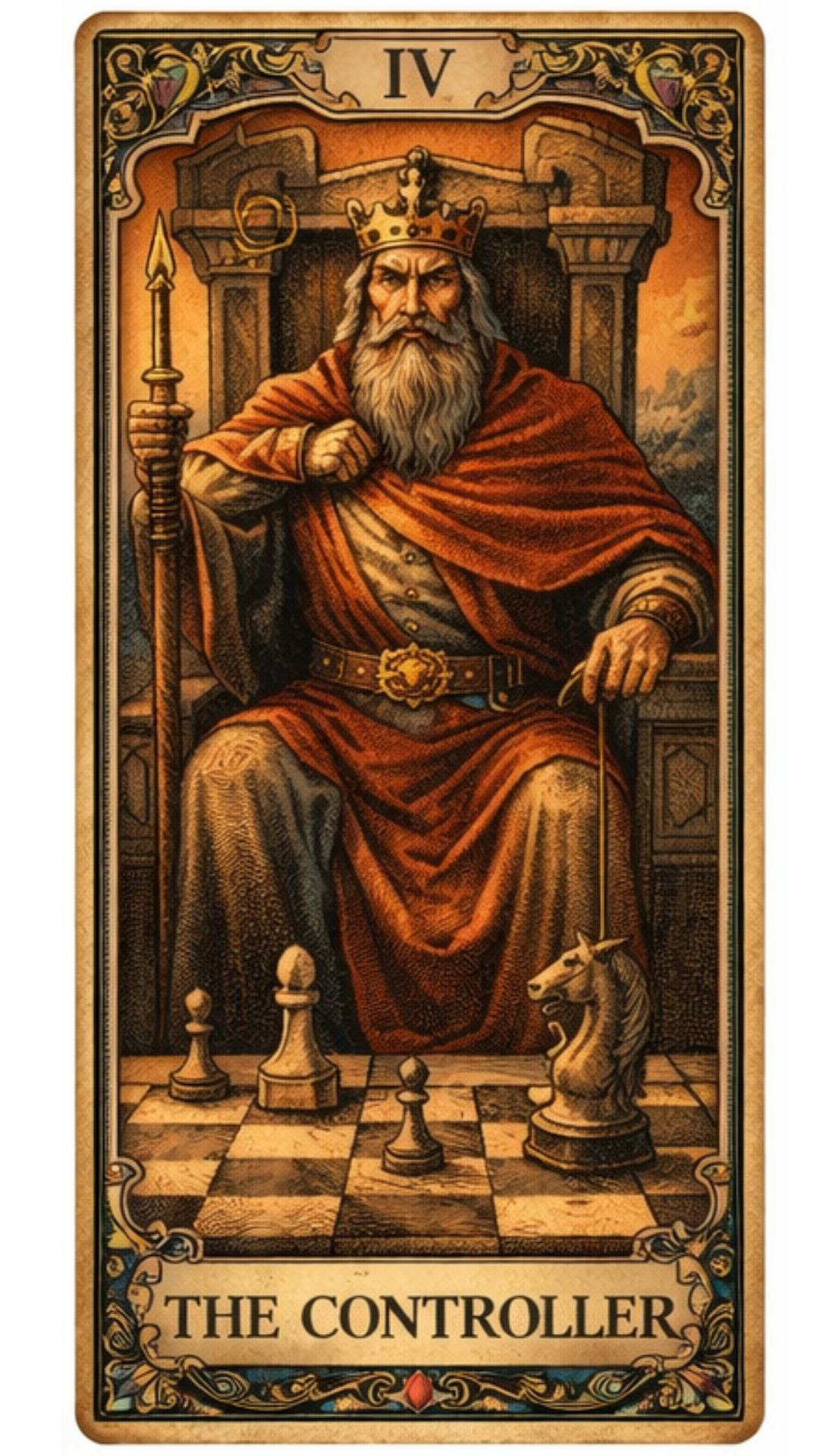
Her name is The Controller.
Who She Is
The Controller is the most capable person in the room.
And she knows it. Not arrogantly, she’d be the first to say she wishes she could rely on other people more. But the evidence, in her experience, keeps confirming the same thing: when she hands something off, it doesn’t get done to the standard she needs. When she loosens her grip, things slip. When she trusts the process, the process lets her down.
So she holds it.
She holds the vision and the details and the relationships and the contingency plans and the backup contingency plans. She holds the team together and the client relationships intact and the finances in view and the calendar organized and the house running and the family coordinated. She holds it all, all the time, because her nervous system has arrived at a conclusion so deeply embedded she’s stopped questioning it:
If I let go, everything falls apart.
She is extraordinary at what she does. The businesses she builds have structure. The containers she creates have integrity. The people in her life know they can count on her because she has never, not once, let them down.
But here is what no one sees: the cost of all that holding.
The jaw that is perpetually tight. The shoulders that live somewhere near her ears. The sleep that doesn’t fully come because her mind is still running contingencies at 2am. The exhaustion she calls dedication. The vigilance she calls responsibility. The control she calls love.
The Controller is not controlling because she’s a difficult person. She is controlling because somewhere, in some room she no longer consciously remembers, she learned that letting go was the most dangerous thing she could do.
What She’s Protecting
The Controller’s deepest fear is not failure. It’s chaos.
Specifically: the chaos that she believes will arrive the moment she stops being the one who holds everything together.
This fear has a history. It always does.
Maybe she grew up in a home where things actually did fall apart when no one was holding them — where a parent’s absence or addiction or emotional unavailability meant that a child had to step into the structural role. Where she learned, young, that someone had to manage this, and no one else was going to do it, so it would have to be her.
Maybe she was in environments — like a construction site, like an industry that didn’t want her there — where any show of uncertainty was immediately capitalized on. Where she learned that control wasn’t a personality trait, it was a survival skill. That the moment she let her grip loosen, someone would step into that space with something she didn’t want.
Maybe she was betrayed by the people she tried to trust, people who didn’t follow through, who let her down at critical moments, who took her money and didn’t do the work. Maybe she remodeled a house and wasn’t paid. Maybe she built something and watched it be taken. Maybe she handed something precious to someone who couldn’t hold it.
Whatever the specific history, the nervous system arrived at the same place: support is not reliable. Trust is not safe. The only thing I can count on is myself.
That is not a character flaw. That is the most rational conclusion a person could draw from those specific experiences.
The Controller isn’t controlling for the pleasure of it. She is controlling because her body genuinely does not yet believe there is another way to be safe.
How She Shows Up in Your Personal Life
In your personal life, the Controller is the woman who is always managing something.
She is the one who knows everyone’s schedule, everyone’s needs, everyone’s emotional temperature — not because she’s nosy, but because she has organized her entire life around anticipating what could go wrong and preventing it before it arrives.
She is the one who doesn’t ask for help, not because she’s proud, but because asking for help requires trusting someone else’s execution. And trusting someone else’s execution requires accepting that it might look different from hers, that the outcome might not be exactly what she envisioned, that she would have to live with the gap between her standard and someone else’s effort. That gap is intolerable to her nervous system.
She is the one who stays in situations she has outgrown — not because she doesn’t know better, but because leaving requires releasing control over the outcome. The known, even when it’s uncomfortable, is always more manageable than the unknown. At least with the known, she can brace for the right things. The unknown requires a kind of trust her system doesn’t have language for.
In intimate relationships, the Controller can create a particular suffocation — not from cruelty, but from the impossibility of being in partnership with someone who genuinely cannot share the steering wheel. She loves. She is loyal. She shows up completely. But she also needs to know what’s happening, when it’s happening, and what will be done if it doesn’t go as planned. The spontaneous, the uncertain, the “we’ll figure it out as we go” — these phrases land in her body like a threat.
Somatically, the Controller lives in the jaw and the shoulders. A chronic bracing. A tension that has been there so long it no longer feels like tension — it feels like posture. Like the baseline state of existing. She may not even know how tight she is until someone puts their hands on her shoulders and she feels the resistance her body has been holding without her permission.
How She Runs Your Business
In your business, the Controller is both the reason you’ve built something real and the ceiling you keep hitting.
She is why your business has structure. Why your clients trust you. Why deliverables get met and systems get built and nothing falls through the cracks. She is extraordinarily good at execution, and the businesses she runs tend to reflect that — organized, professional, reliable.
But she is also why you cannot scale.
Because scaling requires handing things off. It requires building a team and trusting that team to hold things without your hands on every piece. It requires systems that run without you, processes that other people execute, outcomes you don’t personally control. And every one of those requirements runs directly into the Controller’s deepest wound: if I’m not holding it, it will fall apart.
So she stays small. Not because she lacks vision — her vision is often enormous. But because the path to the vision runs through a level of trust that her nervous system is not yet ready to extend.
She is also why your launches feel like military operations. Why you overplan every detail and build contingency into the contingency. Why you micromanage the copy and the design and the tech and the client communication until the people around you feel more managed than supported. Not because you don’t trust them as people — but because the stakes feel so high that trusting anyone else with any piece of it feels like gambling with something you cannot afford to lose.
She is why rest is nearly impossible. Because rest requires releasing the grip. And releasing the grip, even for a weekend, even for an evening, means accepting that things might shift while you’re not watching. The Controller does not find that thought restful. She finds it activating.
And she is why you’re exhausted in a way that goes bone-deep. Not the exhaustion of a sprint — the exhaustion of someone who has been holding a significant amount of weight for a very long time and doesn’t know how to put it down without the whole structure collapsing.
Where She Came From
I spent fifteen years in an industry where control wasn’t a preference — it was the requirement for survival.
On a job site, a mistake doesn’t just mean a bad outcome. It can mean injury. It can mean structural failure. It can mean that the thing you built comes down. So you learn to hold everything in your awareness at once. You learn to anticipate and prevent and manage and brace. You learn that the person who controls the most variables controls the most outcomes.
I was good at it. Genuinely good at it. And I was praised for it — not in soft, appreciative ways, but in the only currency that mattered in those environments: the job got done, the site was safe, the crew respected me, the client got what they paid for.
Control was not just a survival strategy. It was my professional identity. The thing that made me worth the room.
And then I carried it into places where it cost more than it gave.
Into a family situation where I did the work and absorbed the loss because handing off the reins — saying I can’t manage this alone and I need someone else to step in — felt like failure. Into business partnerships where I held more than my share because I didn’t yet know how to trust that someone else could hold weight alongside me without dropping it.
Into my own healing, where I sometimes caught myself trying to control the pace of my integration. Trying to manage the descent. Trying to curate which parts of my shadow came into the light and which ones stayed in the room a little longer, just until I felt more ready.
You cannot control your own healing. That was the lesson the Controller had the hardest time learning.
Because control, at its deepest level, is a grief response. It is what the body does when it has experienced enough loss, enough unpredictability, enough being let down — when it decides that the only reliable protection is its own grip.
The Controller is holding on because she once experienced what it felt like to let go. And what came after was something she decided, somewhere in her body, she would never let happen again.
The Turning Point
There is a particular kind of breaking point that the Controller reaches. It doesn’t look like collapse. It looks like the morning you wake up and your body is so tired from holding everything that it simply cannot gather itself the way it used to.
Not dramatic. Not a breakdown that announces itself.
Just a morning where the grip that has held for years is — for a moment — too heavy to maintain.
For me, it was somewhere in the middle of a season where I was managing a house sale, a business rebuild, a cross-country relocation, a certification exam, a coaching practice, and a healing journey simultaneously. I had a plan for all of it. I had backup plans. I had color-coded lists and contingency thinking and the specific kind of readiness the Controller develops when she’s been managing chaos long enough to make preparedness an art form.
And then something happened that none of my plans had accounted for. Something small. A logistical wrinkle, not a catastrophe.
And I fell apart.
Not proportionally to the actual problem. Proportionally to the weight of everything I’d been holding that wasn’t in any of the plans. All the contingencies I’d prepared. All the scenarios I’d run. All the energy it had cost me to be the one who held this — and I was still here, still facing something I hadn’t anticipated, still not in control of the outcome.
And in that moment, a very quiet and very honest question arrived: What if I had shared some of this? What if I had let someone else hold a piece of it?
Not because they would have done it better. They probably wouldn’t have. But because I would have had something left in me for the moment when the plan didn’t hold.
That’s what the Controller never calculates: the cost of the holding itself. She accounts for every external risk. She does not account for what she spends keeping her grip in place.
The Integration: From Controller to Conscious Architect
Integrating the Controller is not about releasing your standards. It is not about becoming someone who lets things slide or stops caring about quality or decides that “good enough” is a permanent philosophy.
Your standards are real. Your capacity is real. Your ability to hold structure and create containers that actually work — that is one of the most powerful things about you.
The integration is about learning that structure doesn’t have to live in your body tension. That you can build systems, trust people, and delegate pieces without the whole thing unraveling. That support is not a threat — it’s what allows you to actually hold the vision you came here to build.
In your nervous system: Start noticing when the bracing arrives. The jaw. The shoulders. The slight forward-lean that says I’m holding this. When you feel it, don’t try to force relaxation — the Controller cannot be muscled into softening. Instead, ask: What specifically am I afraid will happen if I release this piece? Name the fear precisely. Vague fears run the show. Named fears can be worked with.
In your business: Identify one contained thing you can hand off this week. Not the most important thing. Not the thing with the highest stakes. A small thing, something with a limited blast radius if it’s handled differently than you would handle it. Let someone else hold it. Notice what happens in your body when you do. Notice that the thing probably doesn’t collapse. Let that be data.
In delegation and team: The Controller often struggles to delegate because she hasn’t fully designed the handoff. She tries to give someone a task while still mentally holding the outcome. True delegation requires releasing the outcome, not just the task. That is the practice: handing something over and genuinely letting it belong to someone else, even if they would do it differently.
In rest: Schedule a specific period — two hours, a Sunday afternoon — where you agree with yourself that the grip is off. Not because everything is handled. Because you are choosing to put it down temporarily and trust that it will still be there when you return. Rest is not the absence of responsibility. It is the practice of trusting that your structure is solid enough to hold without your constant hands on it.
A somatic practice to begin: Sit with your hands on your shoulders. Feel the tension that lives there — the tension you may have stopped noticing because it’s been there so long. Breathe slowly and deliberately, and as you exhale, see if you can let your shoulders drop one millimeter. Not all the way. One millimeter. This is not about releasing control. This is about learning that you can soften slightly and the ceiling doesn’t fall. Do that one millimeter, over and over, until your body starts to believe it.
The Gift Inside This Archetype
The Controller, integrated, becomes the most powerful kind of leader.
Because her capacity for structure — her ability to hold vision and build toward it systematically, to create containers that actually function, to see where things could go wrong and build in the architecture to prevent it — does not disappear. It deepens.
What changes is where the structure comes from. Instead of coming from body tension and hypervigilance, it comes from genuine design. From a nervous system that has learned to trust support, to delegate thoughtfully, to build systems that hold weight without requiring her to be the weight-bearer of last resort.
She becomes the kind of leader who can scale. Not because she stopped caring about quality, but because she learned to create it through people and systems rather than through her own perpetual grip.
She builds businesses that don’t require her constant presence to function — and because of that, they actually grow. She creates teams that feel trusted rather than managed, and those teams rise to meet that trust. She designs containers that have integrity because they’re built on real structure, not on her personal vigilance.
And she discovers, often with some surprise, that her standards actually survive the handoff. That the people she trusts do a remarkable job when they’re genuinely trusted rather than micromanaged. That the systems she builds hold more than she expected them to hold.
The Controller’s gift, fully integrated, is this: she stops being the one holding everything and becomes the one who built something strong enough to stand on its own.
That is a different kind of power. A quieter kind. And for the Controller, who has been proving her value through the grip for so long, it is also the most liberating thing she has ever experienced.
This Is Your Invitation
If you recognized yourself in these pages — in the job sites and the jaw tension and the exhaustion of holding it all, in the delegation you can’t quite let yourself do, in the rest that feels like risk, in the particular loneliness of being the most capable person in every room and never quite being able to share the weight of that — I want to say something directly to you.
You have been holding this for a very long time.
You built the grip because you had to. Because the alternative, in the environment you were in, was genuinely unsafe. Because you learned — not from a book but from experience — that letting go had consequences you couldn’t afford.
That was true then. And the version of you who learned it was not wrong.
But the business you’re building now, the life you’re moving toward — it cannot be held alone. Not because you’re not capable. Because the vision is too large for one person’s grip, no matter how strong that person is.
The Embodied Shadow CEO Experience is where we work with this in the body. Not the theory of it — the actual somatic practice of loosening the grip in small, survivable increments. Of building the evidence, experience by experience, that support is real and structure can hold without your constant hands on it.
You’ve carried enough on your own. Come let some of it be shared.
The waitlist is open. This work is waiting for you.
This Is the Final Piece.
If you’re just finding this work, the series begins with the anchor post — Shadow Work for the CEO of Your Life — and moves through all four archetypes: The Performer, The Protector, The Overgiver, and The Controller. Each one is worth reading slowly, with your hand on your chest.
And if you’ve made it here — through all four — something in you already knows this work is not finished. It has only just begun.
Frequently Asked Questions
What is the Controller archetype?
The Controller is one of four Shadow CEO archetypes — a pattern where a high-achieving woman manages, micromanages, and holds every piece of her business and life because her nervous system learned, through real experience, that letting go leads to things falling apart. Her control is not a personality flaw. It is a survival strategy that outlived the environment that created it.
What is the difference between being organized and being a Controller?
Organization is a tool. The Controller’s pattern is a nervous system response. The tell is in the body — the jaw tension, the shoulders near the ears, the inability to rest without feeling activated, the 2am contingency planning that never fully stops. If releasing control feels physically threatening rather than simply uncomfortable, you’re likely in Controller territory.
Why can’t the Controller delegate even when she wants to?
Because delegation requires releasing the outcome, not just the task — and her nervous system has concluded that outcomes are only safe when she’s personally holding them. She often tries to hand off a task while still mentally gripping the result, which isn’t true delegation. The practice is learning to let the outcome genuinely belong to someone else, even knowing they might do it differently.
Why is rest so hard for the Controller?
Because rest requires putting the grip down, and her body interprets that as risk. The Controller cannot fully relax while something is unresolved, unmonitored, or in someone else’s hands. Rest feels irresponsible rather than restorative — not because she’s wrong about needing it, but because her nervous system hasn’t yet learned that the structure holds even when she’s not watching it.
Where does the Controller pattern come from?
Usually from environments where control was genuinely necessary — a home that needed managing when no one else would, an industry or workplace that capitalized on any show of uncertainty, relationships or business situations where trust was extended and then broken. The nervous system drew a rational conclusion from real evidence: support is not reliable, so I will be the only reliable thing.
How does the Controller pattern limit business growth?
Scaling requires handing things off — to teams, systems, and processes that run without her constant presence. Every one of those requirements runs directly into the Controller’s deepest wound. So she stays small, not from lack of vision, but because the path to the vision runs through a level of trust her nervous system isn’t yet ready to extend. The ceiling she keeps hitting is built from her own grip.
How do I start integrating the Controller without abandoning my standards?
Start small and contained. Find one low-stakes thing to hand off this week — something with a limited blast radius if it’s done differently than you’d do it. Let someone else hold it completely. Notice what happens in your body. Notice that it probably doesn’t collapse. Let that be data your nervous system can build on. Integration happens through accumulated evidence, not through deciding to trust all at once.



0 Comments