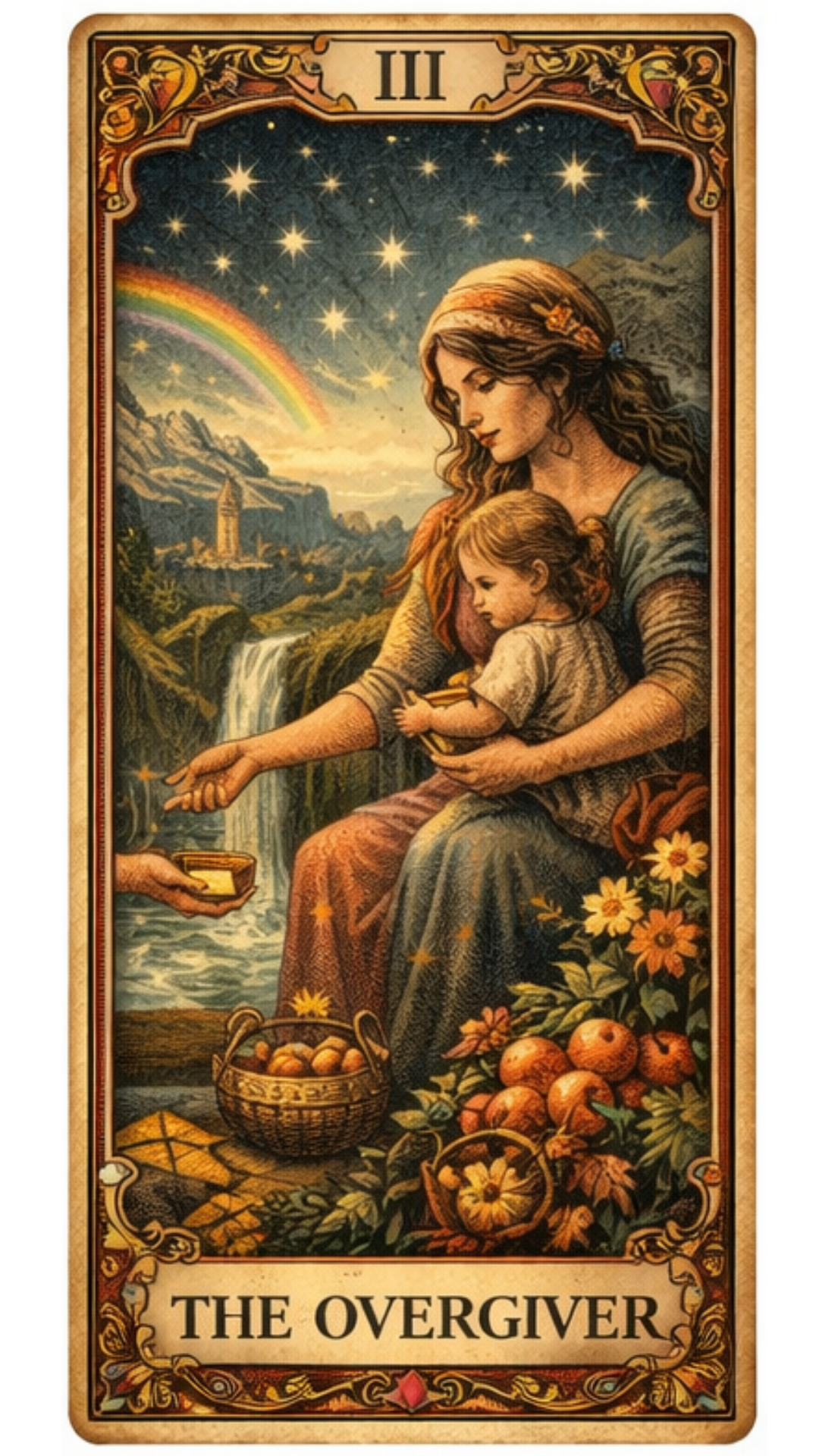
Shadow CEO Archetype Series — Part Three
I remodeled a home for family members.
I managed the contractors. Sourced the materials. Showed up every day with my construction background and my expertise and my whole body, doing work that was worth tens of thousands of dollars.
I never got paid.
Not because there was a misunderstanding. Not because the money didn’t exist. Because I kept saying yes. Because I kept absorbing the discomfort of asking, swallowing the resentment when the check didn’t come, and returning the next day to pour more of myself into something that was not filling me back.
I told myself it was love. I told myself family is family. I told myself that keeping the peace was worth the cost.
What I didn’t tell myself — what I couldn’t see yet — was that I wasn’t giving from love. I was giving from fear. Fear that if I stopped, I’d lose something. Belonging. Connection. The sense that I was valuable enough to keep around.
That’s the difference the Overgiver never talks about: the difference between generosity and self-erasure dressed up as generosity. Between giving because your cup is full and giving because you’ve confused being needed with being safe.
That experience didn’t just wake me up to boundaries. It woke me up to a pattern I’d been running my entire life — in family, in relationships, in business, in the way I showed up for everyone except myself.
If you’ve ever given until there was nothing left and then given a little more — if you’ve ever looked up from the rubble of a situation you poured yourself into and wondered how you got there — you’ve met your Shadow CEO.
Her name is The Overgiver.
Who She Is
The Overgiver is the warmest person in the room.
She is the one who notices when someone is struggling before they’ve said anything. Who shows up with exactly what you needed, often before you knew you needed it. Who holds space so beautifully that people feel seen in her presence in ways they rarely feel anywhere else.
She is the one her friends call at 2am. The one her clients email on Sundays. The one her family leans on because she has always, always been there.
She is genuinely caring. Don’t let anyone tell you otherwise. Her love is real. Her desire to be useful is real. Her capacity to show up for people is not performance — it is one of the most powerful things about her.
But somewhere in that capacity, something went sideways.
She stopped being someone who gives from fullness and became someone who gives to fill herself. She stopped caring as an expression of wholeness and started caring as a strategy for belonging. And the line between those two things is so thin, so invisible, so easy to miss — especially when you’ve been doing it since you were young enough to learn that being needed was the closest thing to being loved.
The Overgiver is generous. And she is running on empty. And she is quietly furious about it, even though she’d never say so, because naming the resentment would mean admitting that the giving wasn’t entirely free.
What She’s Protecting
The Overgiver’s deepest fear is this:
If I stop giving, I will lose my place. If I stop being useful, I will not be chosen. If I have needs of my own, I will become too much — and too much gets left.
This is not a story she invented. It was handed to her.
Maybe she was the child who kept the peace in a home that needed keeping. The one who managed everyone’s emotional temperature so the household could function. The one who learned early that her needs were secondary — not because anyone said so directly, but because the message was in the air, in the exhausted parent who needed her to be easy, in the family system that required her to hold more than her share.
Maybe she was told — explicitly or implicitly — that love is something you earn through service. That worthiness is demonstrated through sacrifice. That a woman who takes up space with her own needs is selfish, and selfish is the worst thing you can be.
So she became the one who gives. And she got very good at it. And she built a life and a business and a personal identity around it, because being the generous one felt safer than being the one who asks for something and gets told no.
The wound underneath the Overgiver is not weakness. It is an intelligence that learned the wrong equation: that love is transactional, that belonging must be purchased, that she is only as safe as she is useful.
She has been paying that invoice for years. And she is exhausted from the cost.
How She Shows Up in Your Personal Life
The Overgiver in your personal life looks like staying long after your body said leave.
It looks like that relationship — the one where you could feel the misalignment from the beginning, where your body was sending signals you rationalized away, where you stayed because leaving felt like abandoning someone who needed you. Because the children needed you there. Because you told yourself the chaos was growth. Because you confused the fact that someone needed you with the fact that the relationship was right.
It looks like knowing — knowing in that deep cellular way — and choosing it anyway. Not because you’re foolish. Because the Overgiver has been trained to override her own knowing in favor of keeping connection intact.
It looks like five ectopic pregnancies and a grief you don’t always name publicly, and still somehow finding yourself in the role of holding other people’s children, other people’s emotional worlds, other people’s healing — because giving love is something you know how to do even when receiving it has felt complicated.
It looks like the man whose trauma you could feel before he said a word. Whose passive-aggression you absorbed because you understood where it came from. Whose healing you wanted for him more than he wanted it for himself, and you stayed in the work of that — the translation, the emotional labor, the careful management of every interaction — until your body finally said enough before your mind caught up.
Somatically, the Overgiver lives in the chest and the limbs. A heaviness. A tiredness that isn’t about sleep. A low-grade guilt that hums underneath everything, and a resentment that lives right beside it — because guilt and resentment are the Overgiver’s twin companions. The guilt says you should give more. The resentment says you have given everything. Both of them are always there, always in conversation, and neither one gets resolved by giving more.
How She Runs Your Business
In your business, the Overgiver is the pattern underneath every number that doesn’t match your expertise.
She is the reason your pricing is lower than it should be. Not because you don’t know your worth — you know your worth. But charging what you’re actually worth means some people won’t be able to afford you, and the Overgiver cannot tolerate the idea of someone needing what she has and being unable to access it. So she discounts. She extends. She makes exceptions. She tells herself it’s generosity when it is actually an inability to hold a clean exchange.
She is the reason your client relationships sometimes feel more like caretaking relationships. The ones where you know more about their nervous system than your own. Where you bend the container to accommodate their process, absorb their bad weeks, give extra sessions that were never on the invoice. Where you work harder on their results than they do, and somewhere underneath your professionalism is a quiet panic: what if they don’t get there? What if I didn’t give enough?
She is the reason you overdeliver on every offer. Not because you designed it that way, but because the moment you sense someone might be disappointed, the Overgiver floods the system with more. More content. More access. More of yourself. Until the boundary between your business and your body is so blurred you don’t know where the offer ends and your personal life begins.
She is the reason you say yes before you check in with yourself. The reason your calendar fills with other people’s priorities. The reason you arrive at Sunday afternoon having served everyone around you and find that your own work — the thing you’re actually here to build — is still waiting.
And she is the reason you feel resentful in ways you’re ashamed of. Because you chose all of this. No one forced you. You said yes and you said yes and you said yes, and now you’re exhausted and quietly angry and you don’t feel entitled to the anger because wasn’t this what you wanted? To be helpful? To be needed?
Yes. And also no. You wanted to be loved. And somewhere the wires got crossed.
Where She Came From
I have spent most of my adult life caring for people in some capacity.
Men on job sites who needed managing. Clients who needed strategy. Family who needed my labor, my expertise, my time, my silence about the fact that I wasn’t being compensated. A mother I moved to Maine to care for. Partners I stayed with past my own knowing. Children who weren’t mine but who I loved like they were, because my body still wanted to mother even after five pregnancies that didn’t survive.
I gave in all directions. I gave from my construction knowledge, my business expertise, my emotional intelligence, my spiritual sensitivity. I gave advice, space, presence, money, time.
And I told myself this was love.
Some of it was. Genuinely. But some of it was the oldest equation my nervous system knew: if I am useful, I will not be abandoned. If I am needed, I am safe.
My father left in the way some fathers leave — not all at once, but in the gradual accumulation of absences that a child eventually learns to stop expecting to be filled. That wound doesn’t announce itself. It just quietly shapes the template for every relationship that comes after. It writes an equation in your body: to be loved, you must earn it. To be kept, you must be necessary.
I became necessary everywhere I went. On the job site. In my agency. In my family. In my relationships. In all of my work.
The Overgiver wasn’t a character flaw. She was the most rational response to the world I grew up in. She kept me connected. She kept me chosen. She kept me safe.
She also kept me empty.
The Turning Point
There’s a moment I keep returning to.
It was after the house. After the work was done and the money wasn’t coming and the conversation I kept not having because having it would mean disturbing a peace that was already broken.
I was sitting with the reality of what I had done — not what had been done to me, but what I had allowed. The Overgiver doesn’t like that distinction. She’d prefer to be the victim of other people’s taking. That story is cleaner. It keeps the wound on the outside.
But the harder truth was this: I had known. I had felt the wrongness of it early. My body had sent signals I overrode because the discomfort of conflict felt more dangerous than the slow drain of being used.
I had chosen this. Over and over. Not because I was stupid. Because I was running a program that said: keeping connection is worth any price.
That recognition broke something open in me. Not in a dramatic way. In the way that a truth breaks open — quietly, irrevocably, rearranging everything that comes after.
I started asking a different question. Not how can I give more? but what is this costing me? And is the connection I’m purchasing with this cost actually real?
Because here is what the Overgiver eventually has to face: the belonging she has been buying is not belonging. It is proximity. It is dependency. It is the warmth of being needed, which feels like love but is not love.
Love does not require you to disappear inside it.
The Integration: From Overgiver to Conscious Giver
Integrating the Overgiver is not about becoming cold. It is not about building walls or deciding that care is weakness or learning to be strategic about your warmth.
Your warmth is real. Your capacity to hold space, to sense what people need, to love deeply — these are not the problem. These are the gift.
The problem is the equation underneath the giving. The integration is about rewriting that equation. Not from the mind, the mind has understood this for a long time. From the body.
In your nervous system: Start noticing the difference between giving that feels like expansion and giving that feels like relief. Expansion means your cup is genuinely full and the offering comes from overflow. Relief means something in you relaxed when you said yes — the anxiety of disappointing someone, the fear of losing their warmth. One is generosity. The other is appeasement. They feel different in the body if you slow down enough to feel.
In your pricing and offers: Hold your number. The full number. Without explaining it into pieces, without apologizing for it, without building in exceptions before anyone even asks. Let the number be a complete sentence. The people who are meant for your work will find a way. The ones who use your softness to negotiate you down are showing you, in that very moment, that they do not yet understand the value of what you carry.
In your client relationships: Your clients need your boundaries more than they need your endless availability. A container with clear edges teaches people how to be held. A container with no edges teaches people that you can be dissolved. One of those is actually serving your clients. The other is serving your fear of their disappointment.
In your personal relationships: Practice receiving without immediately giving back. Let someone do something for you and resist the urge to reciprocate before you’ve actually felt the gift. This is harder than it sounds. The Overgiver is deeply uncomfortable in the receiving position because receiving without giving feels like debt — and debt feels like danger.
A practice to begin: Before you say yes to anything this week, pause. Put your hand on your chest. Ask your body — not your mind, your body — am I choosing this from fullness or from fear? You don’t have to change the answer yet. Just learn to know which one is speaking.
The Gift Inside This Archetype
The Overgiver, integrated, becomes something the world is genuinely hungry for.
Because her capacity to feel, to hold, to care is not the problem. It is extraordinary. It is rare. There are very few people who can sense what someone needs before they name it, who can create space that feels genuinely safe, who can love with the kind of constancy the Overgiver carries.
When that capacity is rooted in a self that she has not abandoned — when she gives from fullness rather than fear, from choice rather than compulsion — the work she does becomes something else entirely.
Her clients don’t just feel supported. They feel seen in ways that change them. Her relationships don’t drain her. They feed her, because she has learned to receive as fluently as she gives. Her business doesn’t feel like a series of performances of generosity. It feels like an honest exchange between two people who both know their worth.
She becomes the model for what reciprocal love actually looks like. Not the watered-down version she settled for before. The real thing — where both people bring their whole selves to the table, and no one has to disappear to keep the connection alive.
That is the Overgiver’s gift, fully integrated: love that is honest. Care that doesn’t cost her herself. A business built on genuine exchange rather than the slow hemorrhage of giving without receiving.
She doesn’t stop being generous. She stops using generosity as currency.
And when that shift happens — when she finally trusts that she is wanted, not just useful — she becomes more powerful than she has ever allowed herself to be.
This Is Your Invitation
If you recognized yourself in these pages — in the homes, the relationships, the unpaid labor, the yes that came before the check-in, the resentment you feel guilty for feeling — I want you to say something you may not have said out loud yet:
I have given more than was sustainable. And I am ready to do this differently.
Not because you’re done loving people. Because you’re ready to stop abandoning yourself inside the love.
The Embodied Shadow CEO Experience is where we work with this directly. We look at where the Overgiver is running your business, your pricing, your client relationships, your calendar, your sense of your own value. We move it through the body, not just the mind, because that’s where this pattern actually lives.
We don’t make you less generous. We make your generosity honest.
If something in you knows it’s time — the waitlist is open. Come as you are. You don’t have to have this figured out first.
The final piece in this series explores The Controller — the Shadow CEO archetype driven by certainty, who learned that the only way to be safe was to hold everything together herself.
Frequently Asked Questions
What is the Overgiver archetype?
The Overgiver is one of four Shadow CEO archetypes — a pattern where a high-achieving woman gives compulsively in business and relationships, not from fullness, but from a fear of losing belonging, connection, or safety. Her generosity is real, but it’s driven by an unconscious equation: to be needed is to be safe.
What is the difference between generosity and overgiving?
Generosity comes from a full cup — you give because you have overflow. Overgiving comes from fear — you give to avoid disappointment, maintain connection, or prove your worth. The key difference isn’t the act, it’s what’s underneath it. One expands you; the other quietly drains you.
How does the Overgiver show up in business?
She underprices her offers, overdelivers on every client, absorbs bad weeks that aren’t hers to hold, says yes before checking in with herself, and fills her calendar with everyone else’s priorities. She works harder on her clients’ results than they do — and then feels resentful about choices she made herself.
Why do I feel resentful when I’m the one who loves to give?
Because the giving was never entirely free. Resentment and guilt are the Overgiver’s twin companions — guilt says give more, resentment says you’ve given everything. Both live alongside each other and neither gets resolved by giving more. The resentment is a signal that something in the exchange isn’t honest.
Where does the Overgiver pattern come from?
Usually early. It often develops in childhood — being the peacekeeper, the easy one, the child whose needs were secondary. The nervous system learns: if I am useful, I will not be abandoned. That equation gets carried into adult relationships, business, and pricing without ever being examined.
How do I know if I’m an Overgiver or just a caring person?
Ask yourself: does saying yes feel like expansion, or like relief? Expansion means your cup is full and you’re sharing overflow. Relief means anxiety relaxed when you said yes — the fear of someone’s disappointment, or of losing their warmth. One is care. The other is appeasement. They feel different in the body if you slow down enough to notice.
How do I start breaking the Overgiver pattern?
Start with one practice: before you say yes to anything, pause, put your hand on your chest, and ask your body — not your mind — am I choosing this from fullness or from fear? You don’t have to change the answer yet. Just learn to know which one is speaking.





0 Comments